
Starting an agricultural drone business can be lucrative, but it requires careful planning and compliance with regulations. Here’s a quick breakdown of what you need to know:
- Costs & Revenue: Startup costs can be under $100,000, with potential earnings of $6,000–$12,000 per day. Pricing typically ranges from $12 to $19 per acre.
- Licenses & Compliance: You’ll need an FAA Part 107 Remote Pilot Certificate, a Part 137 Agricultural Aircraft Operator Certificate, and a state pesticide applicator license. Additional exemptions may apply for drones over 55 pounds.
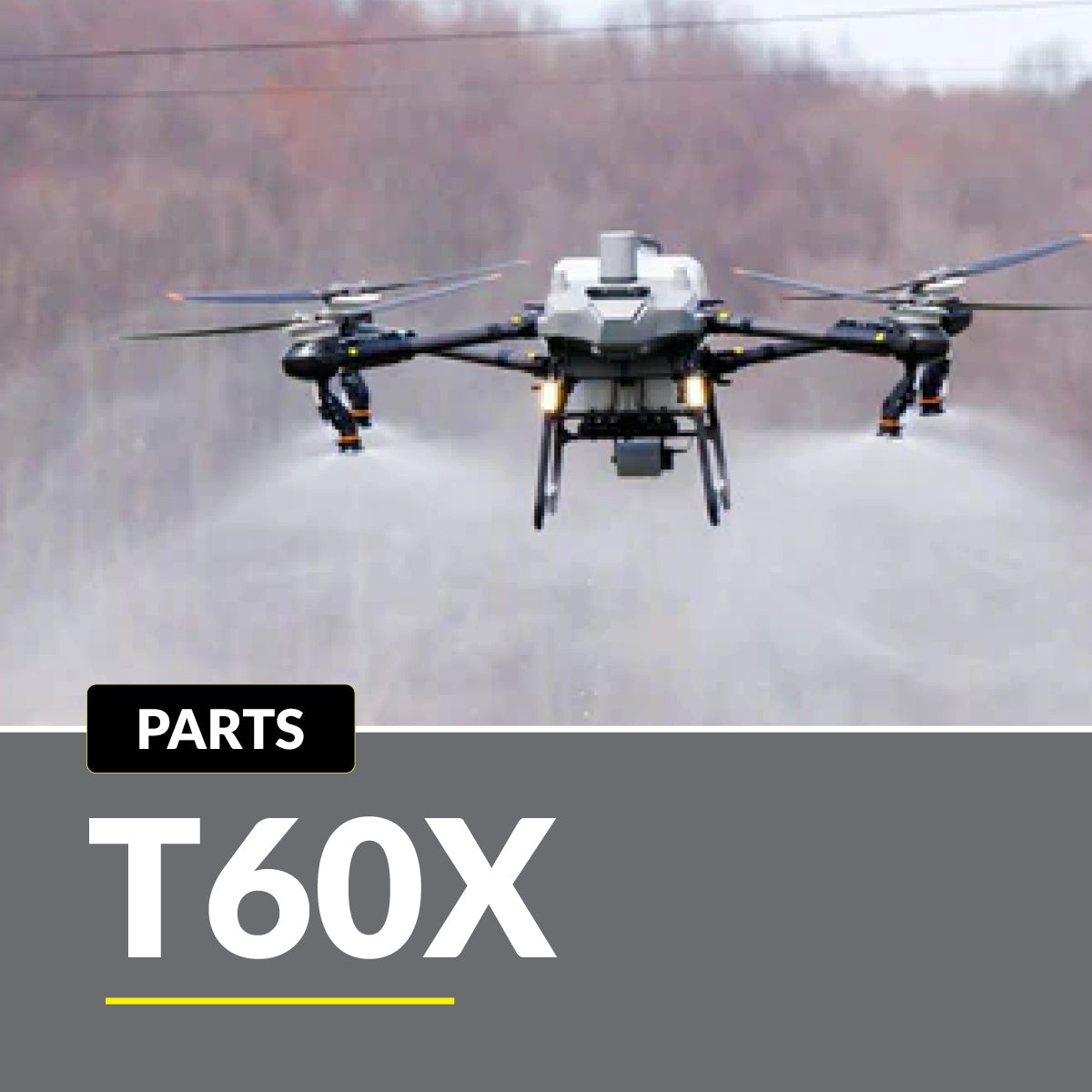
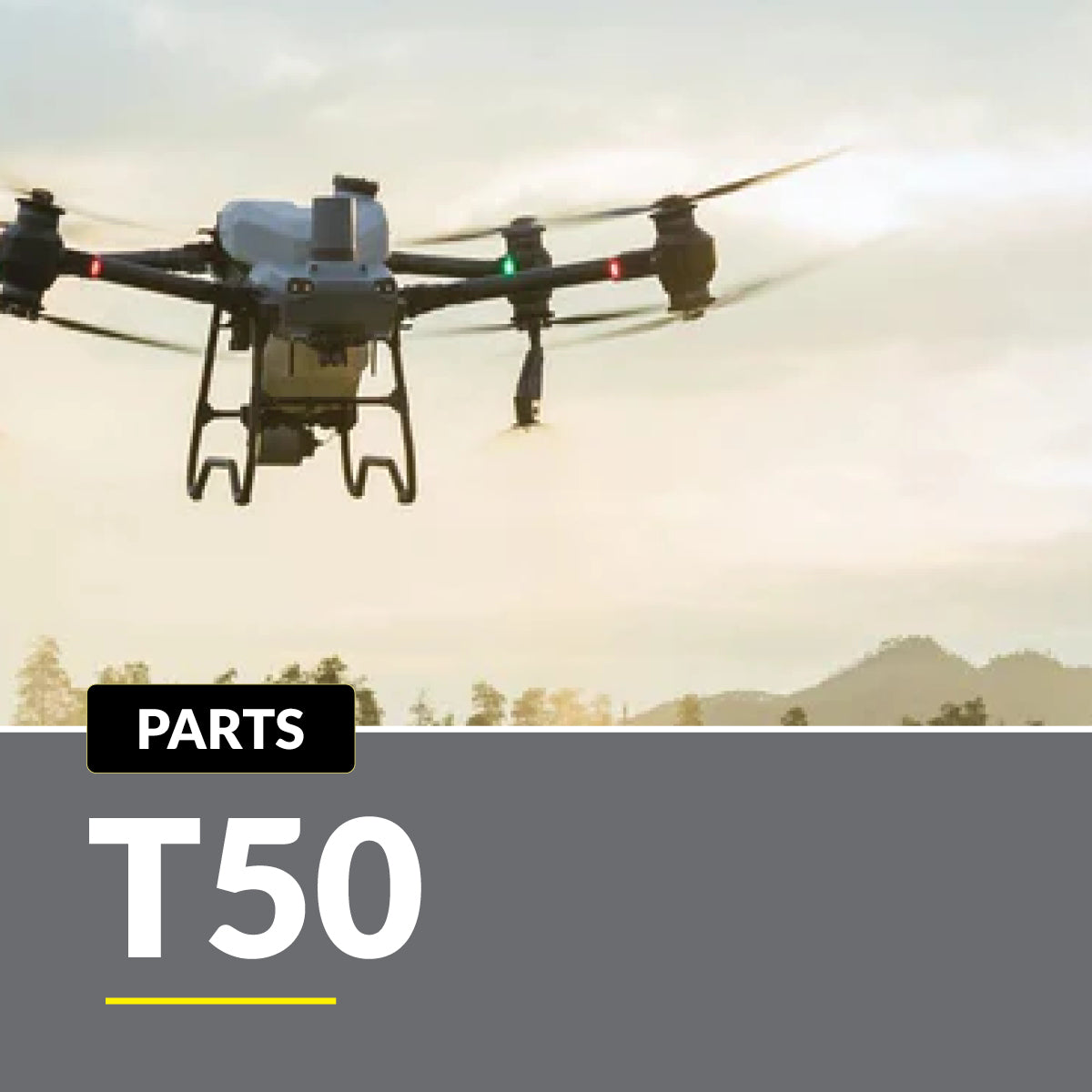
- Equipment: Popular drones include the DJI Agras T50 or T60X, costing $19,999–$35,595. Ground support tools like trailers, generators, and safety gear are essential.
- Operations: Efficient logistics, pre-flight safety checks, and proper maintenance are key to maximizing acreage coverage and minimizing downtime.
- Insurance: Liability and hull insurance are must-haves to protect your business and equipment.
- Growth: Covering 600–800 acres daily can help scale operations. Partnerships with chemical retailers or direct client acquisition can boost revenue.
This guide walks you through each step, from planning and licensing to equipment selection and scaling your business.
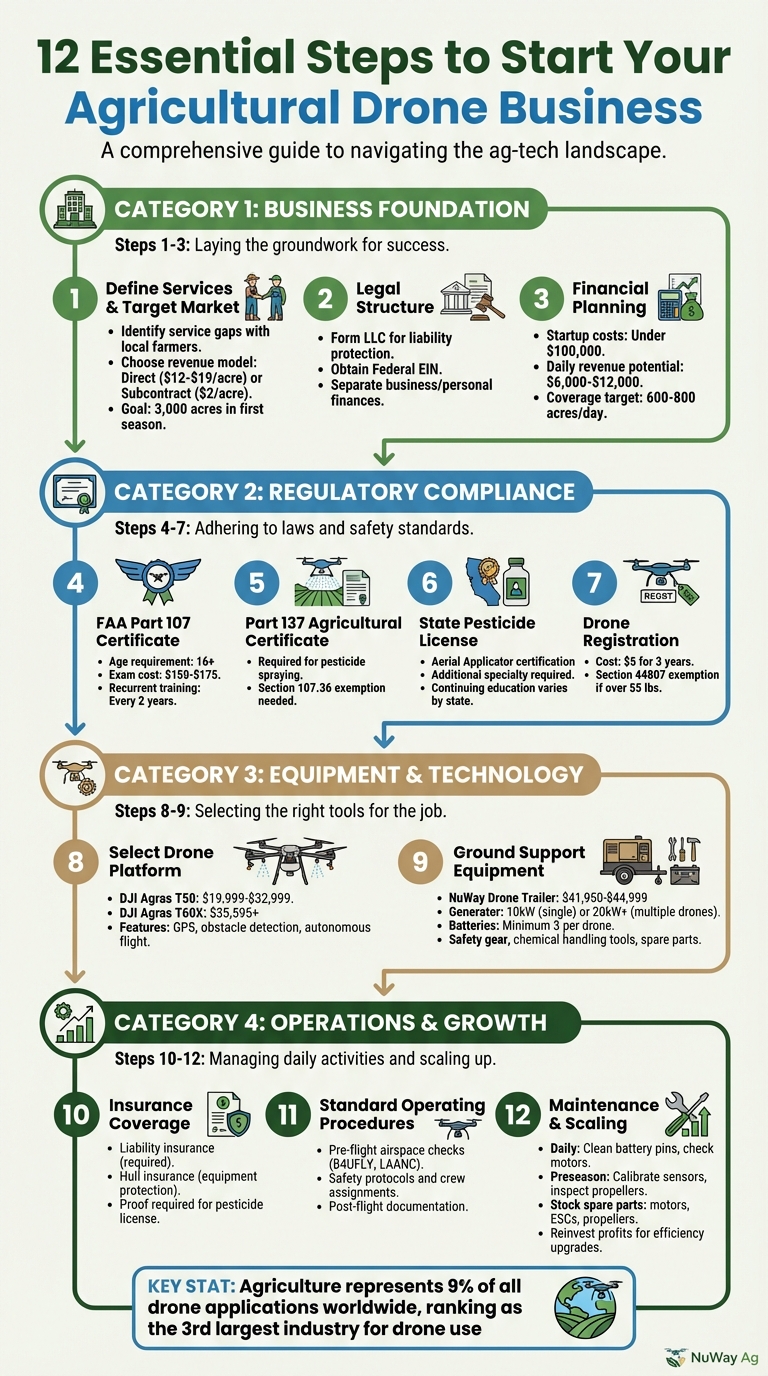
Agricultural Drone Startup Checklist: 12 Essential Steps to Launch Your Business
From Helicopters to Drones: Brandon's $50K Startup Journey in Agricultural Aviation (D$1K S 7 Ep 3)
Creating Your Business Foundation
Start with a clear business plan that outlines your target market and revenue model. Agriculture makes up 9% of all drone applications worldwide, ranking as the third-largest industry for drone use. Farmers face challenges like monitoring crop health, applying treatments in fields too wet for heavy equipment, and using aerial mapping for precision farming.
Talk to local farmers and chemical retailers to identify service gaps. Are traditional crop-dusting services too expensive or unavailable? Do small, irregular fields make conventional equipment inefficient? You could subcontract for chemical retailers that lack their own application teams, earning about $2 per acre while they handle billing. If you work directly with farmers, aim to spray at least 3,000 acres in your first season to establish momentum.
Setting up the right legal structure is critical. Most agricultural drone businesses choose an LLC (Limited Liability Company) to protect personal assets from potential liabilities like equipment crashes or chemical drift issues. Don’t forget to obtain a Federal Employer Identification Number (EIN) to open a business bank account and manage tax documentation. Separating personal and business finances isn’t just smart; it’s a safeguard if problems arise in the field.
Plan your finances carefully. Startup costs for agricultural drone services are relatively low compared to traditional crop-dusting. Expenses include the drone itself, ground support equipment, insurance, and licensing fees. For revenue, U.S. Midwest pricing for application services typically ranges from $12 to $19 per acre, with farmers supplying the chemicals. In areas like Northeast Ohio, rates generally average between $14 and $17 per acre. A well-run operation covering 600 to 800 acres daily on large, open fields could bring in $9,000 to $12,000 in gross revenue per day.
Companies like NuWay Ag can help you lay a solid foundation. Based in Dundee, Ohio, their team offers tools like business plan templates and marketing packages tailored for agricultural drone startups. They’ve helped many operators avoid common pitfalls, such as underestimating field logistics or choosing the wrong equipment. Whether you need help budgeting or creating a client acquisition strategy, working with experienced advisors can save you significant time and effort. Once your foundation is in place, you’ll be ready to tackle regulatory requirements and choose the best equipment for your business.
Meeting U.S. Regulatory and Licensing Requirements
To run a successful agricultural drone business, following both federal and state regulations is non-negotiable. These rules not only protect your business but also ensure smooth and lawful operations. The FAA oversees drone operations, while state agricultural departments regulate the safe use of chemicals. Together, these guidelines form the foundation for a trustworthy and efficient drone service.
FAA Requirements for Drone Operations
If you’re flying drones commercially, you’ll need a Remote Pilot Certificate with a small UAS rating. Here’s what that entails:
- Be at least 16 years old.
- Pass an aeronautical knowledge exam at an FAA-approved testing center (costs range from $150 to $175).
- Complete TSA security vetting.
Before taking the exam, you’ll need to create an IACRA profile to get your FAA Tracking Number (FTN). While your certificate doesn’t expire, you must complete free online recurrent training every two years to keep your flying privileges current.
Each drone must also be registered through the FAA DroneZone for $5, with the registration valid for three years. Drones under Part 107 (weighing less than 55 pounds at takeoff, including payload) must follow specific operational rules: stay within visual line of sight, fly no higher than 400 feet above ground level, and ensure at least 3 statute miles of weather visibility. If you’re flying in controlled airspace (Class B, C, D, or E), you’ll need prior authorization through LAANC applications.
For agricultural spraying, additional certifications come into play. While Part 107 governs general flight operations, spraying pesticides requires an Agricultural Aircraft Operator Certificate (AAOC) under Part 137. Since carrying hazardous materials is prohibited under Section 107.36, you’ll need an exemption to spray pesticides. If your drone weighs 55 pounds or more when loaded, you’ll also need a Section 44807 exemption and must operate under Part 91. Additionally, any accidents involving injuries or property damage over $500 must be reported to the FAA within 10 days.
After meeting FAA requirements, check your state’s pesticide licensing rules to ensure full compliance.
State Pesticide Licensing
To legally spray chemicals with drones, you’ll need a pesticide applicator license specific to your state. Most states require an Aerial Applicator certification paired with another specialty, like Field Crop Pest Control or Vegetation Management.
"Typically the licensing board of your state will require you to obtain at least one other certification besides the aerial application one (aerial application certification alone is not sufficient to obtain the pesticide applicator license)."
- Hylio
Reach out to your state’s Department of Agriculture to confirm the exact requirements and fees. The process usually involves studying and passing exams, and some states may require hands-on training or apprenticeships lasting up to a year. For example, in Texas, applicators must complete 15 Continuing Education Units (CEUs) every five years to maintain their licenses. Even if your license is recognized in other states through reciprocity agreements, you’ll still need to register in each state where you operate and keep meticulous records of flights and chemical applications. This license also allows you to purchase Restricted Use Pesticides (RUPs) - essential for specialized agricultural tasks.
Insurance and Risk Management
Once your licenses are in order, the next step is securing insurance to protect your operations. Insurance is a must-have, given the risks involved. The FAA’s requirement to report property damage over $500 and your responsibilities as Pilot in Command make liability coverage critical. Most state licensing boards also require proof of liability insurance before issuing a commercial pesticide applicator license.
Consider two key types of coverage:
- Liability insurance: Covers damage to crops, property, or injuries to people.
- Hull insurance: Protects your drone equipment in case of accidents.
NuWay Ag’s team can help connect you with insurance providers experienced in agricultural drone operations. They can also guide you in determining the right coverage levels for your business. With proper insurance and licensing in place, you’ll be ready to focus on selecting equipment that aligns with both your regulatory obligations and operational goals.
Selecting Your Equipment and Technology
With your licenses and insurance in place, the next step is equipping your operation with the right tools. The goal? Minimize downtime and maximize efficiency. Here's a breakdown of the key equipment categories to get your operation running smoothly.
Choosing Your Drone Platform
When picking an agricultural drone, prioritize ready-to-fly (RTF) systems. These drones come equipped with GPS navigation and autonomous flight planning, enabling precise spray patterns without manual intervention. Safety features like Active Phased Array Radar and Binocular Vision are critical for detecting obstacles like power lines, trees, or buildings, ensuring safe operation in complex environments.
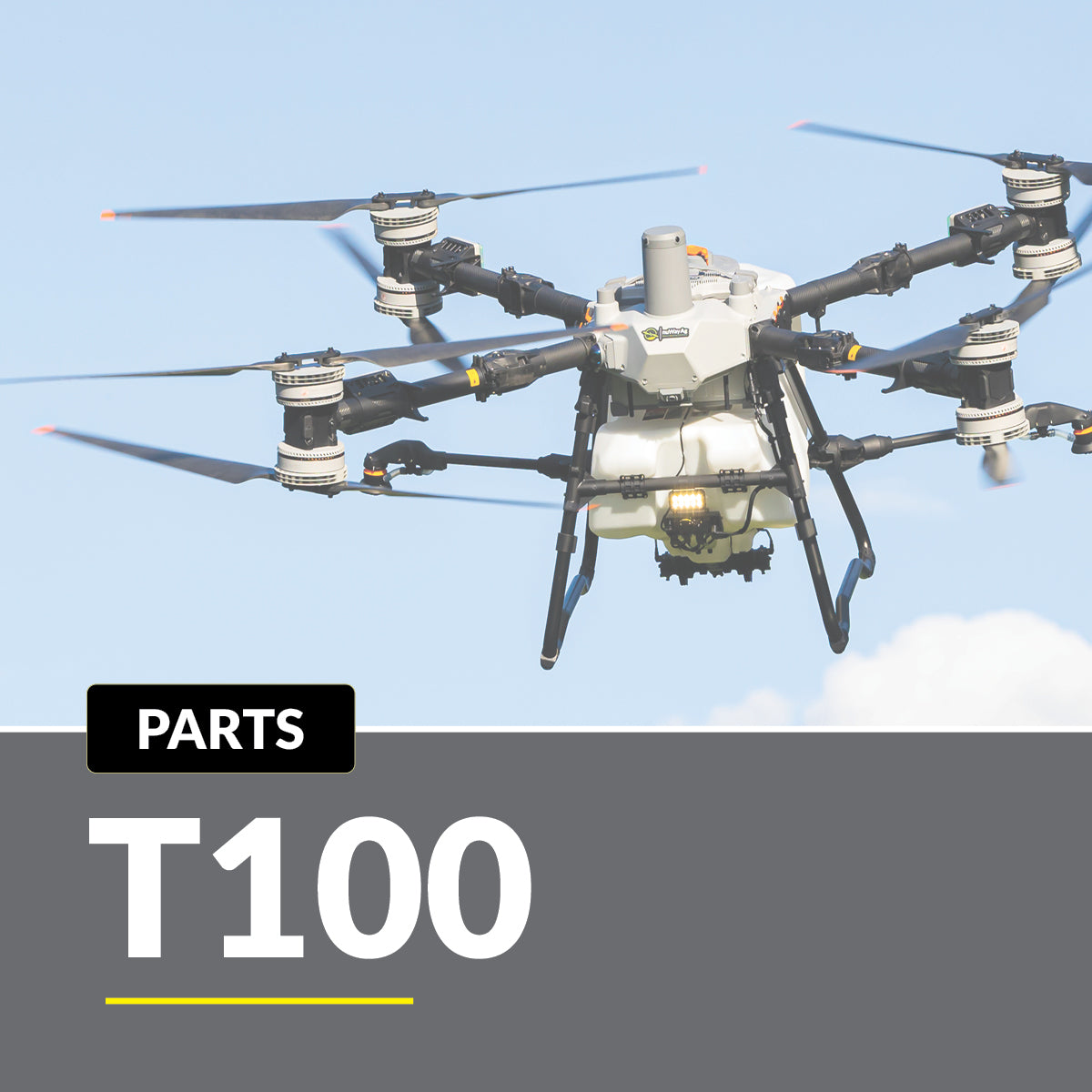
Popular options for U.S. startups include the DJI Agras T50 and T60X. The T50 Complete Generator Kit costs $32,999 and includes everything you need: the drone, generator, batteries, cooling station, and even coaching. If you already have a generator, the Complete Charger Kit is available for $29,999. For seasoned operators, the T50 Drone Only package costs $19,999. The T60X offers similar kits with upgraded features, starting at $35,595 for the complete generator kit. NuWay Ag simplifies the process with these all-in-one kits, ensuring all components work seamlessly together from day one.
Ground Support Equipment and Accessories
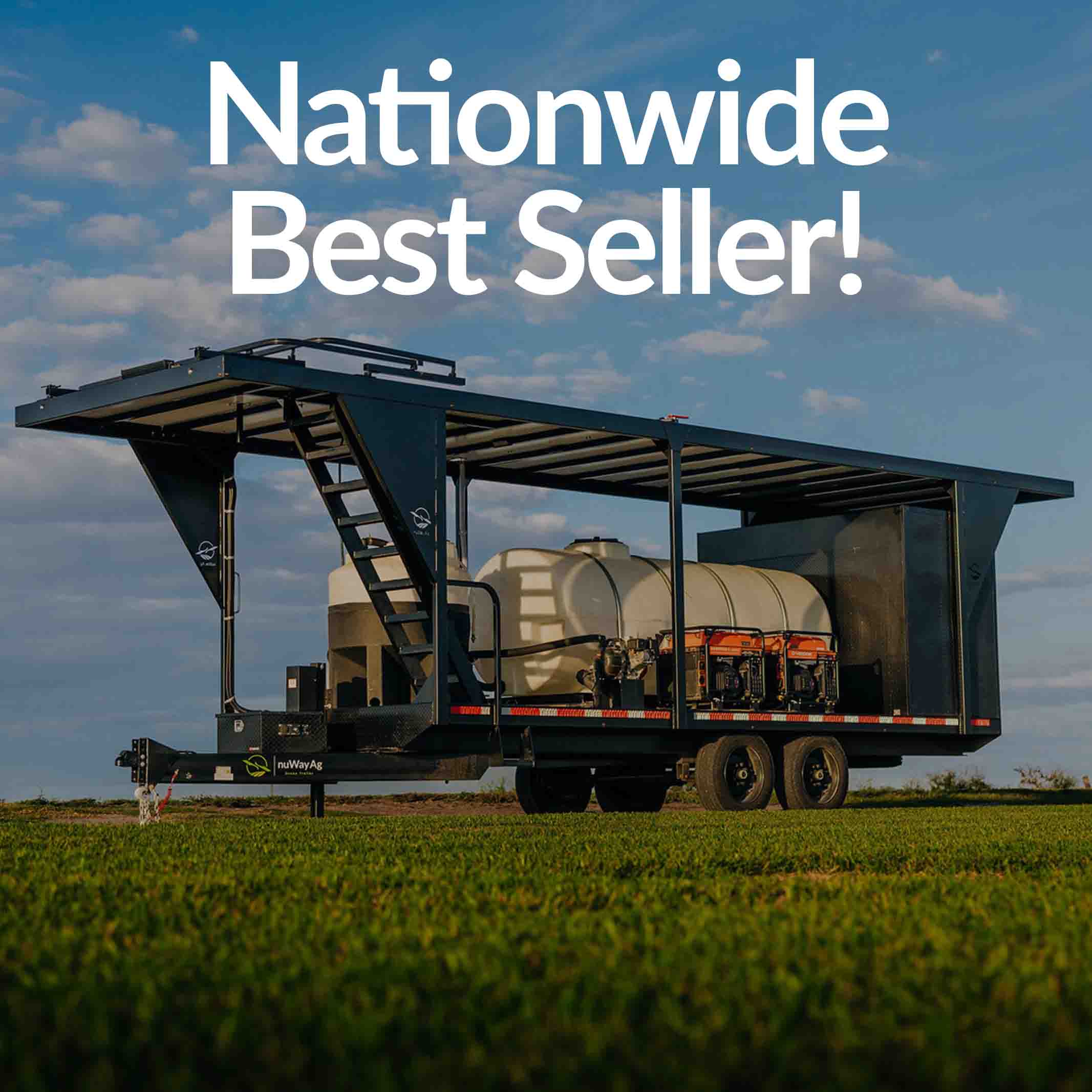
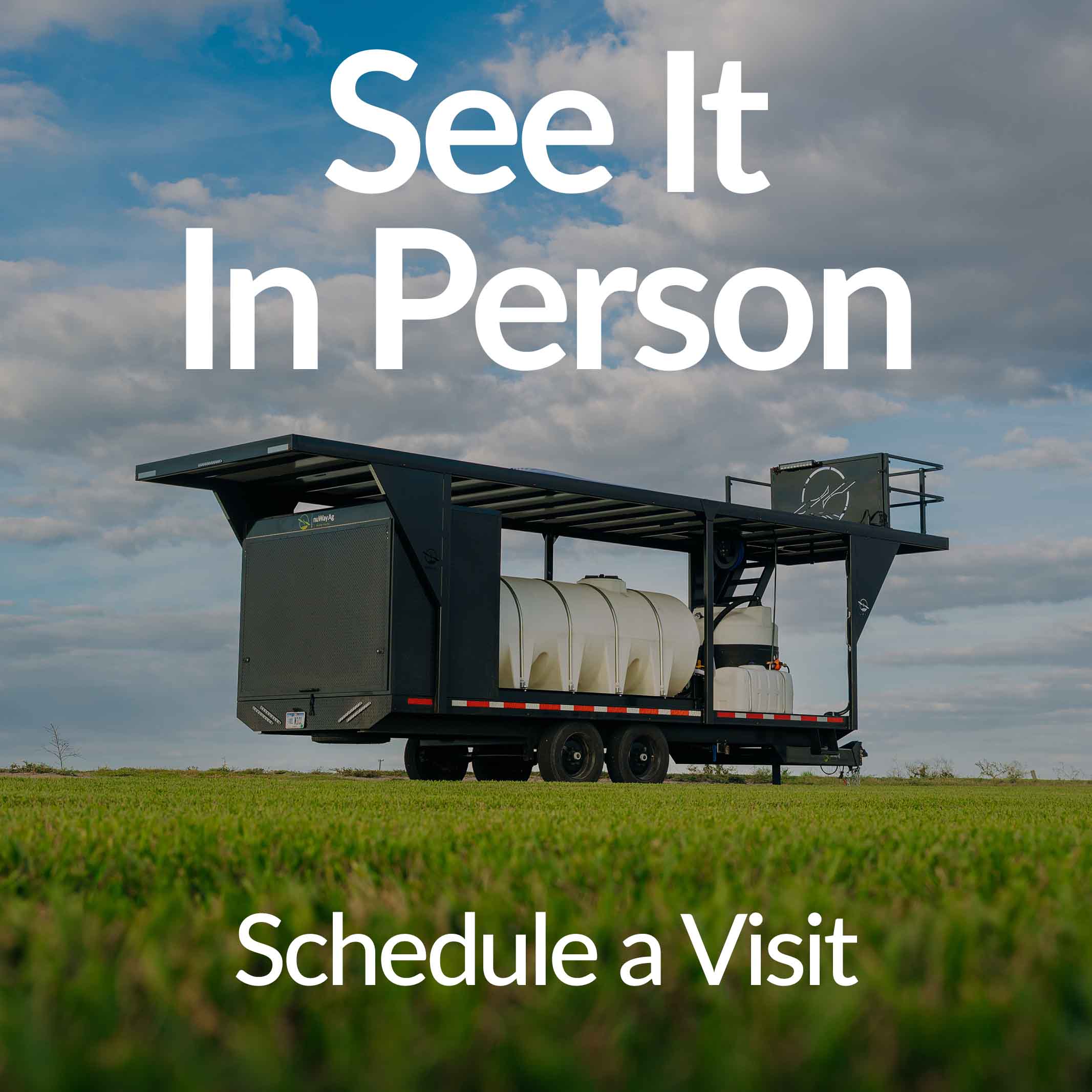
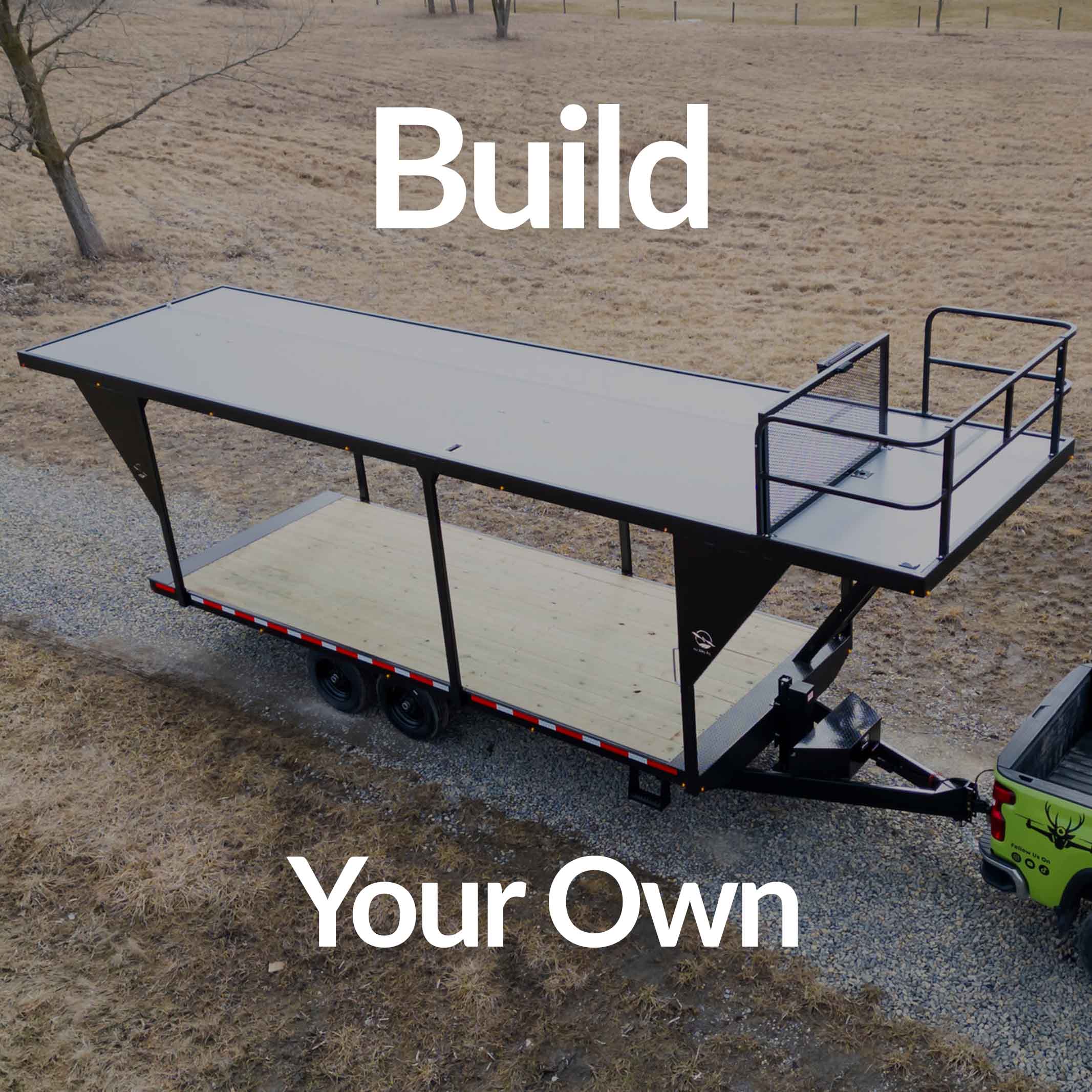
Your ground support setup is essential for efficient operations. The nuWay Drone Trailer serves as a mobile command hub, integrating mixing tanks, pumps, and charging stations into a single platform. For example, "Mike's Loadout", designed for the T50 and T60X, is priced at $41,950, with gooseneck versions available for $44,999. These trailers are built for high-capacity operations, handling over 1,000 acres per month. Remarkably, spraying just 250 acres can cover most monthly equipment payments.
To power your drones, you'll need a generator. A 10,000W generator works for single-drone operations, while 20kW or larger is better for running multiple drones simultaneously. For continuous flight cycles, plan on having at least three batteries per drone - one in use, one charging, and one cooling. Allow batteries to cool before recharging to extend their lifespan.
Your field kit should also include chemical handling tools like holding tanks, high-flow pumps, and heavy-duty hose reels. Safety gear is crucial: pack an anemometer to measure wind speed, a fire extinguisher, a first aid kit, collapsible safety cones, hi-viz vests, and personal protective equipment like goggles and hard hats. For maintenance, bring isopropyl alcohol for motor cleaning, soft brushes, spare propellers, and tools for tightening screws and connectors. Keeping spares on hand for these high-use items can prevent costly downtime in the field.
Software and Connectivity Tools
Before each flight, ensure you're compliant with airspace regulations. Use tools like the FAA’s Visualize It, the B4UFLY app, and the LAANC system to verify airspace permissions.
For mission planning and data management, consider software like DJI Terra and Pix4D Fields, which transform aerial imagery into actionable maps for crop scouting and damage assessment. With DJI Smartfarm, you can manage spray missions, monitor drone health, and organize field data across multiple operations. NuWay Ag also provides an agricultural spray map subscription to help streamline field mapping and business management.
Connectivity can be a challenge in rural areas due to terrain, trees, or buildings. To maintain a stable connection between your remote controller and drone, hardware like the DJI Relay is invaluable. Always carry multiple high-speed SD cards and a mobile device loaded with mission planning software to manage field data and compliance logs on-site.
With the right technology and tools in place, you're setting the foundation for safe, efficient, and effective drone operations. Up next: focusing on operational safety and maintenance procedures.
sbb-itb-3415cd9
Setting Up Field Operations and Safety Procedures
Once your equipment is ready, the next step is to establish a solid framework for safe and efficient field operations. This means creating processes that ensure compliance, keep drones in the air, and maintain reliable service.
Standard Operating Procedures
Before every flight, it's essential to check airspace restrictions using tools like B4UFLY or Visualize It and conduct a thorough site assessment for potential obstacles. If you're flying in controlled airspace - Class B, C, D, or E - you’ll need to secure authorization through the LAANC system. Always have your remote pilot certificate and the drone's FAA registration (N-number) on hand.
To minimize downtime, centralize key equipment like drones, chargers, and hoses. When handling chemicals, use dedicated mixing tanks and keep a 50-gallon water tank on-site for handwashing and rinsing equipment. For nighttime or twilight operations, equip your drone with anti-collision lights visible from at least three miles away.
After each mission, postflight documentation is just as critical. Record detailed flight and spray data, including acreage covered, chemicals applied, and any issues encountered. This not only ensures compliance but also helps identify trends that can improve efficiency over time.
By establishing these procedures, you create a strong operational foundation that can be further refined through training.
Training and Coaching for Operators
Having standard procedures is only part of the equation - operator training is what ensures smooth execution in the field. While passing the FAA Part 107 exam is a legal requirement to fly, it doesn’t prepare you for the complexities of operating a heavy-duty agricultural drone like the DJI Agras T40. As NuWay Ag explains:
"Efficiently operating the T40 is not as easy as the Matrice 30T or a smaller drone. It will require some practice".
Hands-on coaching is invaluable for learning how to handle real-world spraying scenarios. From unboxing and setup to managing battery cycles and refueling mid-mission, practical experience is key.
NuWay Ag offers personalized coaching at their Dundee, Ohio headquarters, included with the purchase of an agricultural drone. These sessions feature water-run practice on nearby fields, giving new operators the chance to master spray patterns, flight planning, and logistics under the guidance of an experienced instructor.
Field Safety and Logistics
A well-trained crew can step seamlessly into clearly defined safety roles. Safety starts with assigning responsibilities: under Part 107 regulations, the drone must remain within the visual line of sight (VLOS) of either the remote pilot or a designated visual observer. Assign tasks so that one person focuses on flying the drone, another handles chemical mixing, and a third monitors the field for obstacles or hazards. This division of labor ensures smooth operations and minimizes risks.
Crew members working with chemicals must wear proper personal protective equipment (PPE), such as gloves and goggles, as specified on pesticide labels.
Emergency preparedness is also a must. Develop clear protocols for handling equipment failures, chemical spills, or medical emergencies. Know the location of the nearest hospital, and keep emergency contact numbers easily accessible. Having tools like a hydraulic jack and an integrated manifold system on your trailer can streamline setup and teardown, keeping your drone operational and maximizing the acreage you can cover each day.
Maintaining Equipment and Planning for Growth
To keep your drone business running smoothly and ready for expansion, focus on maintaining your equipment and planning for growth. Daily upkeep ensures your drone stays operational, while strategic planning sets the stage for scaling your operations.
Routine Maintenance and Repairs
Keeping your drone in top shape starts with daily cleaning. Use 95% alcohol and a cotton swab to clean battery pins - this simple habit can extend the life of both your batteries and your drone. Before every flight, spin each motor by hand to check for resistance or irregular movement, which could signal issues like coil corrosion or a broken bearing. Also, ensure the drone's arms are tightly secured using a 16 mm socket wrench. Loose arms not only affect flight stability but also compromise spray accuracy.
Preseason maintenance is just as crucial. Recalibrate weight sensors, pumps, and flow meters before the busy season begins. For example, the DJI Agras T40's spraying system should deliver a maximum flow rate of 3.1 gallons per minute when functioning correctly. Regularly inspect propellers and replace them in pairs, along with new gaskets, if you notice any damage. As DJI Agriculture points out:
"A preseason maintenance check is not just proactive; it's a strategic move... ensuring that your T40 and its components are in top condition before you hit the fields can prevent costly downtimes and potential accidents."
For more complex repairs or firmware issues, visit a DJI Certified Service Center. NuWay Ag highlights the benefits of such services:
"As a DJI Certified Service Center, we can also repair drones, provide maintenance and sell parts. We provide you with everything you need to keep your business flying."
To avoid unnecessary delays, keep essential spare parts on hand, ensuring you're always prepared for quick fixes.
Stocking Spare Parts and Building Backup Systems
Having the right spare parts ready can save you significant downtime in the field. Keep a stock of motors, Electronic Speed Controllers (ESCs), and propellers (always replaced in pairs with fresh gaskets). Use the correct tools to avoid damaging screws, and organize your parts in labeled containers for easy access.
Battery management is another critical aspect. Fast charging systems or dedicated battery stations can cut down turnaround time between missions. For nighttime operations, keep spare strobe lights that meet FAA visibility standards (visible from at least three statute miles). A well-equipped workbench and a landing pad to protect your motors from debris can also improve your efficiency in the field.
Scaling Your Operations
Once your maintenance and repair systems are reliable, you’ll be ready to scale your operations to handle larger workloads. NuWay Ag underscores the link between efficiency and revenue:
"As a drone pilot, your revenue is tied directly to your efficiency. Cover more acres, make more money."
For example, a two-drone setup can cover 600–800 acres daily in large, open fields or 300–500 acres in smaller, more fragmented areas. Even spraying fewer than 250 acres per month can often cover most equipment payments.
Reinvesting profits wisely is key. Upgrading to a NuWay Ag drone trailer with built-in pumps and tanks can significantly reduce setup and teardown time - often more impactful than simply adding more drones. For even greater efficiency, consider the T60X model with a 60-liter tank, which boosts efficiency by 27% per battery charge compared to standard setups.
Strategic partnerships can also help you grow. Subcontracting with chemical retailers gives you access to their customer base, though these services typically charge around $2 per acre for administrative support. Additionally, diversifying your lead generation through local farm shows, free demos, and an active online presence ensures farmers can easily find and hire your services.
The 12-Point Startup Checklist
This 12-point checklist takes you through the essentials of starting and running your business, from planning the groundwork to managing daily tasks and scaling up.
Business Foundation:
Clarify your services and pinpoint your target market. Set up a legal structure and craft a financial plan that accounts for equipment, operational costs, and spray pricing (typically $12–$19 per acre).
Regulatory Compliance:
Make sure you’re covered on all regulatory fronts. Obtain your FAA Part 107 and Part 137 certificates, get your state pesticide license, register your drone (a $5 fee for three years), and secure a Section 44807 exemption if your drone weighs over 55 pounds.
Equipment Selection:
Choose the right tools for the job. Consider drone platforms like the DJI Agras T40 or T50, capable of spraying 32–40 acres per hour. Add essentials like NuWay Ag drone trailers, a high-output generator, flight planning software, and portable Wi-Fi to your setup. These investments are key to ensuring smooth and efficient operations.
Operations and Maintenance:
Follow a solid plan for daily operations and upkeep. Use pre-flight checklists, establish emergency procedures, and train operators to maximize acre coverage. Keep up with daily maintenance tasks and stock up on critical spare parts. As your business grows, reinvest your profits to improve efficiency and upgrade your equipment.
FAQs
What regulations do I need to follow to start an agricultural drone business in the U.S.?
To run an agricultural drone business in the U.S., you need to follow the FAA's Part 107 regulations for small unmanned aircraft systems (UAS). This involves earning a Remote Pilot Certificate, which requires passing the Part 107 test, and registering any drone that weighs between 0.55 lbs and 55 lbs. Each registered drone must also display its FAA-assigned identification number.
Some key operational rules include keeping the drone within your visual line of sight, flying only during daylight or civil twilight (or at night if you have a waiver), and avoiding any reckless or unsafe maneuvers. If you plan to operate in controlled airspace, you’ll also need airspace authorization.
For more advanced activities, such as agricultural spraying, you might need additional certification under the FAA's Part 137 rules. These tasks may also require specific waivers if they exceed the standard Part 107 limits. Since FAA regulations can evolve, it's essential to stay informed about any updates that may affect your operations.
What are the best ways to scale my agricultural drone business?
Building a successful agricultural drone business starts with solid groundwork. First, make sure all your pilots are certified under FAA Part 107 and meet any state-specific agricultural regulations. Keep all certifications and compliance documents well-organized in a digital format - this not only simplifies onboarding but also ensures easy access when needed. Regular drone maintenance is another must. Clean motors, check battery health, and inspect your drones after every flight to reduce downtime and extend their lifespan.
For a smoother path to growth, consider using NuWay Ag’s startup kits. These kits include a ready-to-use business plan template, marketing tools, and even in-person coaching to help you expand into new territories. Pair this with the NuWay Drone Trailer, which makes transporting multiple drones and payloads a breeze. This setup allows your team to cover more ground and service more farms in less time.
As your business grows, focus on building a team of certified pilots and appoint a fleet manager to oversee maintenance and daily operations. To attract new clients, invest in targeted marketing efforts such as email campaigns, social media outreach, and trade show appearances. Highlight the ROI of your DJI-powered technology to demonstrate the value of your services. With the right combination of tools, processes, and a skilled team, you can scale your business efficiently while keeping costs in check and profits on track.
What equipment and tools are essential to start an agricultural drone business?
To build a thriving agricultural drone business, you'll need the right mix of equipment, safety gear, and technology. Start with a dependable agricultural drone like the DJI T100, T50, or T60X. These models offer generator-powered spray systems that deliver consistent coverage, making them ideal for large-scale farming needs. Keep essential spare parts on hand - propellers, motors, batteries, and chargers - as well as a spraying kit with tanks, pumps, nozzles, and fluid lines for seamless replacements and efficient workflows.
Safety should always come first. Equip your team with an anemometer to measure wind speed, a fire extinguisher, hard hats, high-visibility vests, safety goggles, and a first-aid kit. These items not only meet safety standards but also ensure your crew stays protected during operations. For transport and storage, a dedicated drone trailer provides secure, weatherproof storage and simplifies on-site logistics.
Technology is another key component. A ground-control station, whether a tablet or laptop, is essential for processing aerial imagery, creating NDVI maps, and offering actionable data to clients. Pair this with a solid business foundation that includes a clear business plan and effective marketing strategies to position your services for growth and long-term success.